Chilliwack field notes, October 18, 2026. A gravel-bar haul, ten photographs, and a lot of provisional names.
The numbered identifications are provisional, from an AI-assisted photo review. No physical tests are recorded. Jade, aventurine and agate remain unconfirmed.
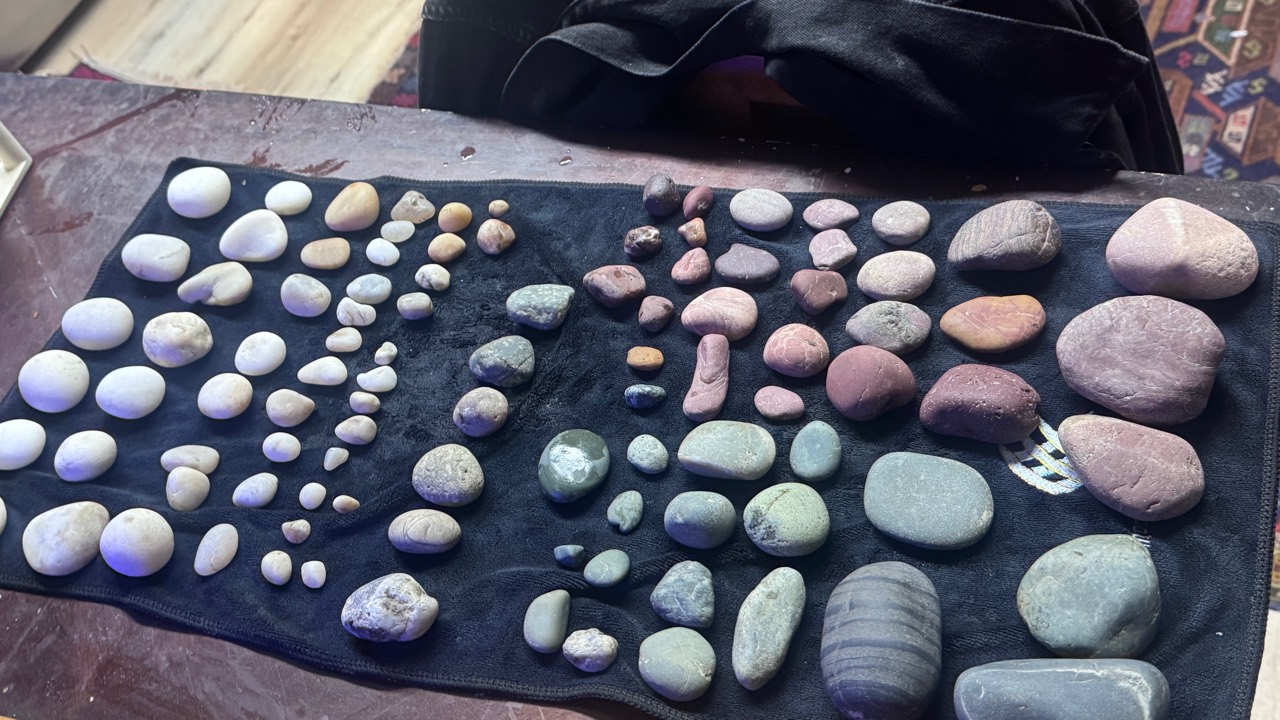
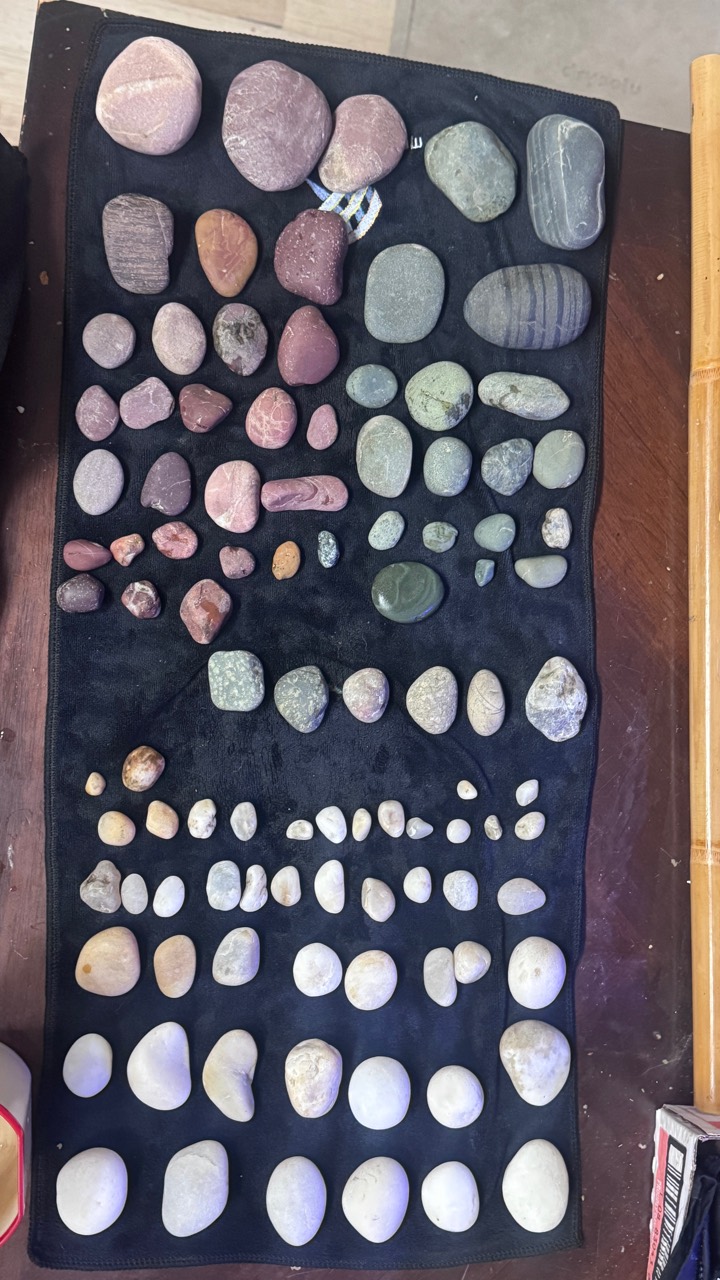
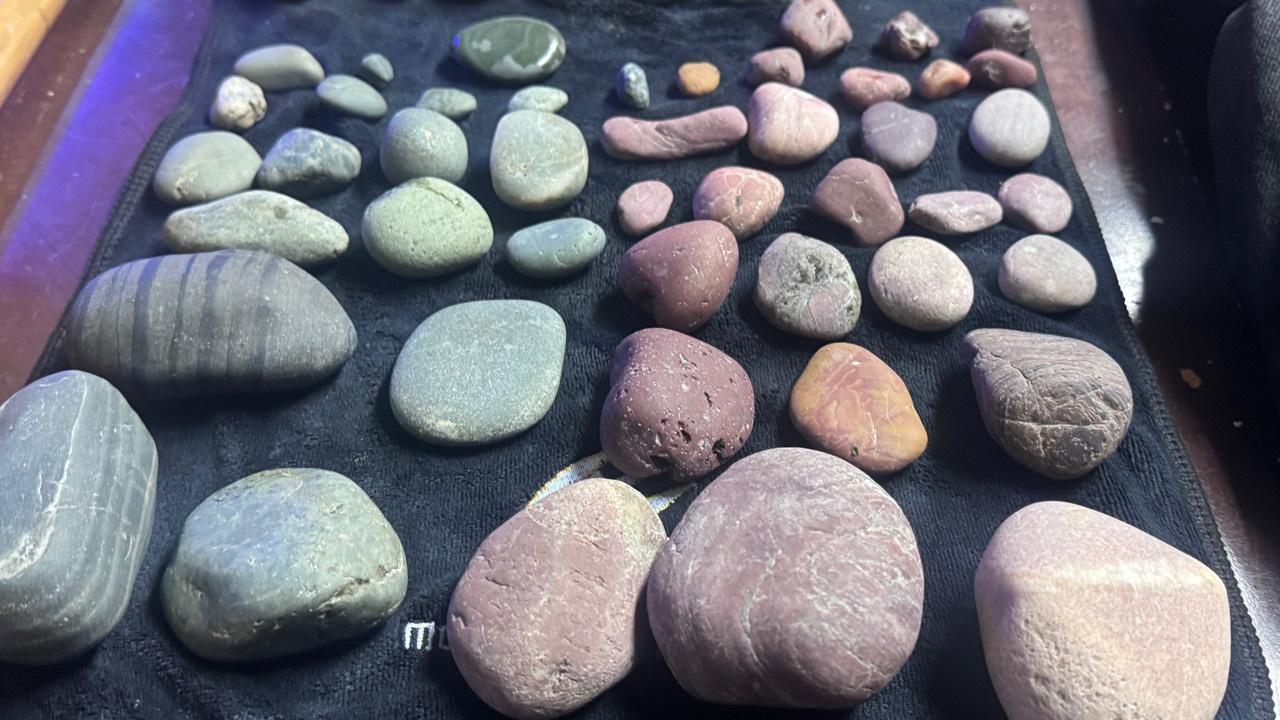
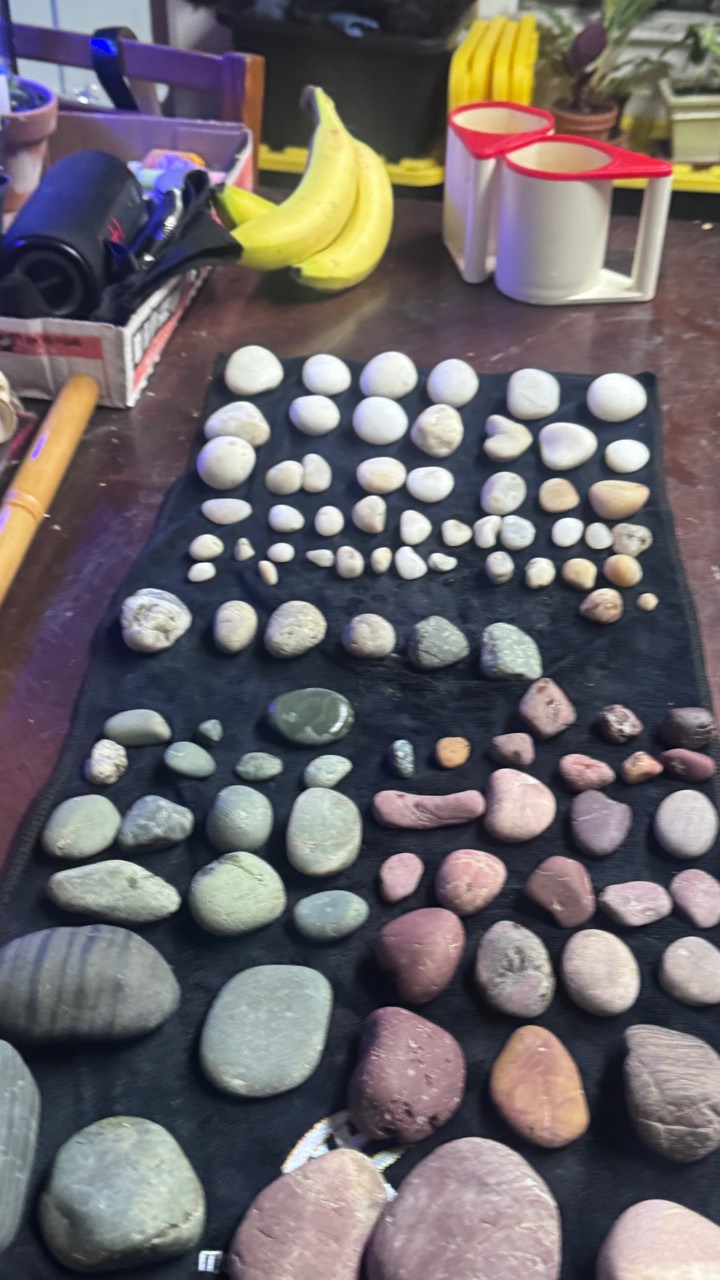
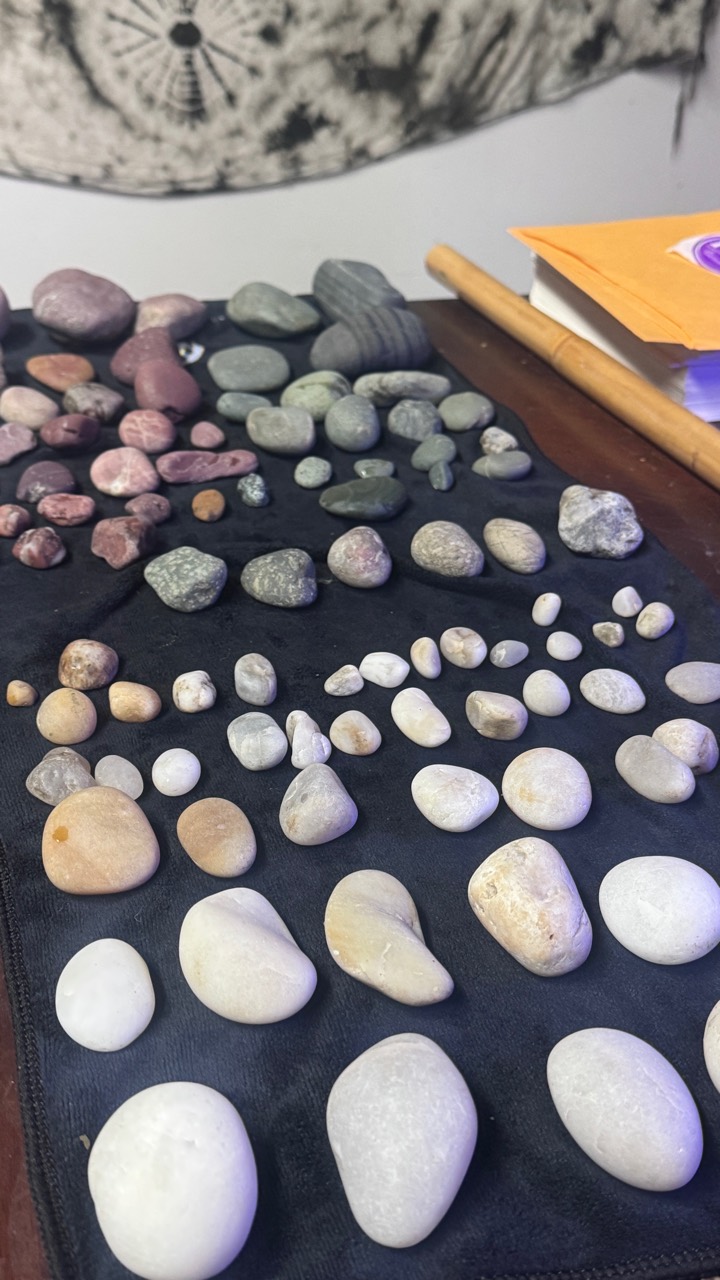
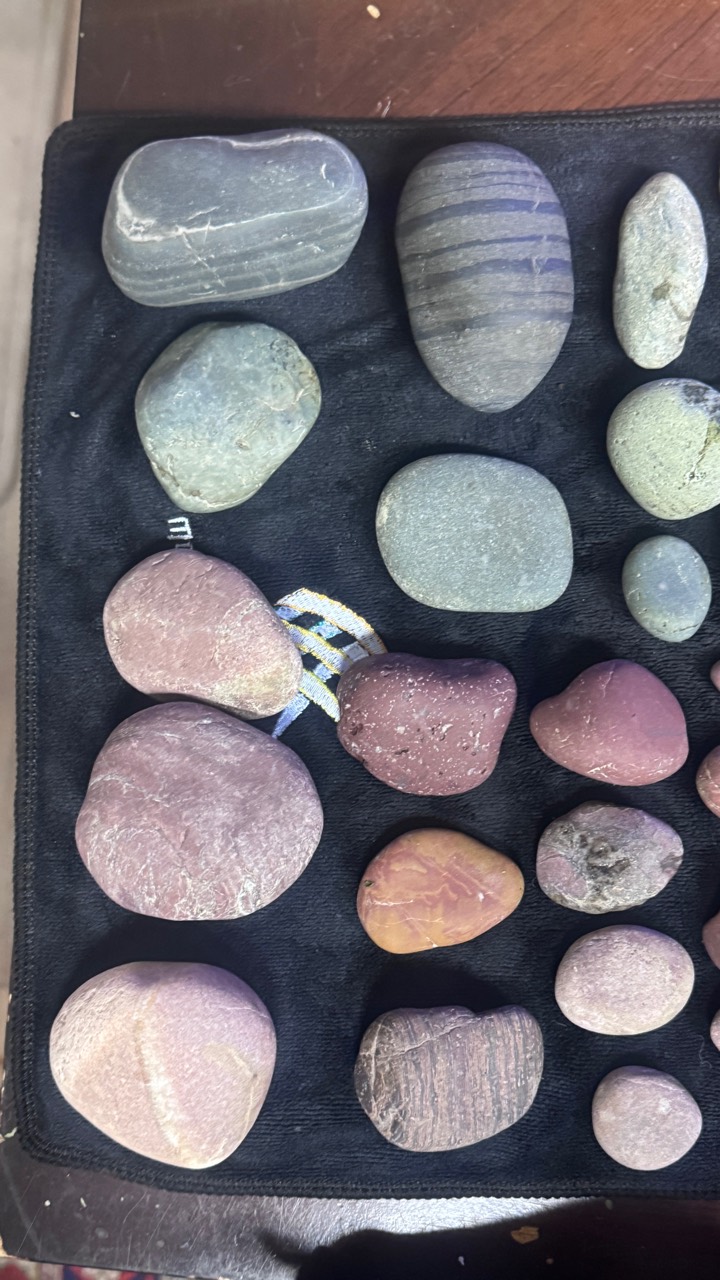
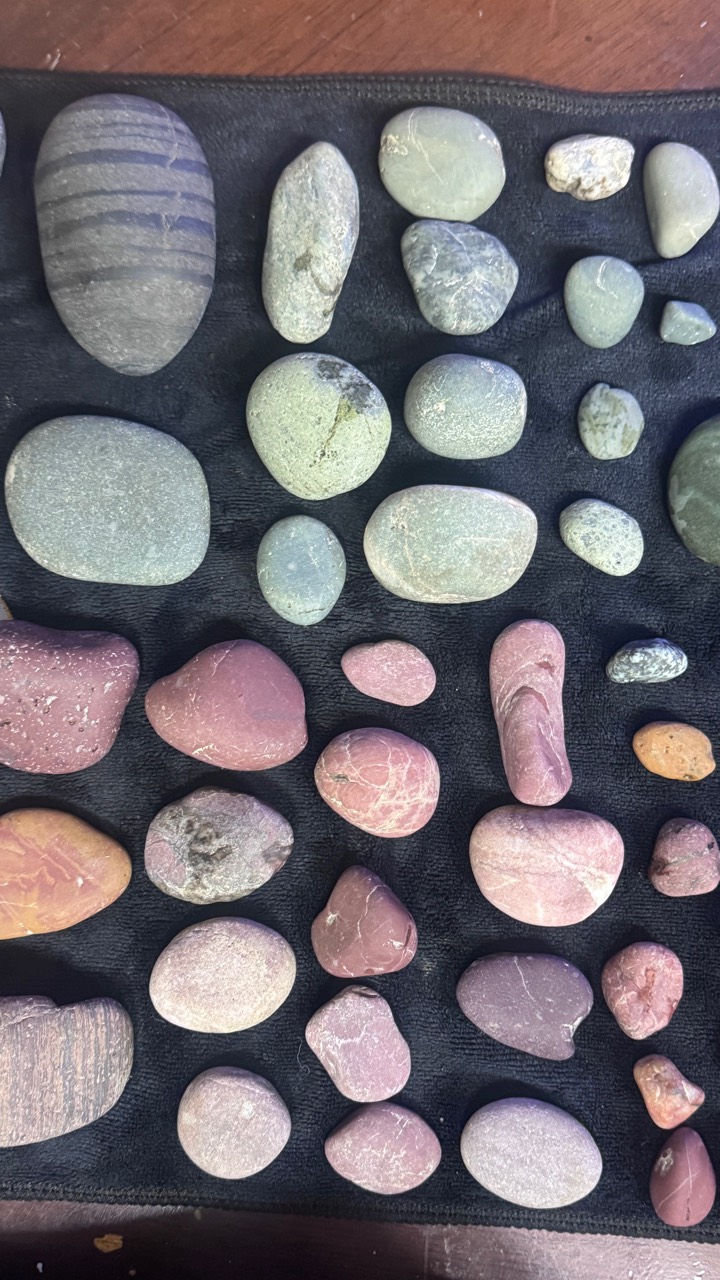
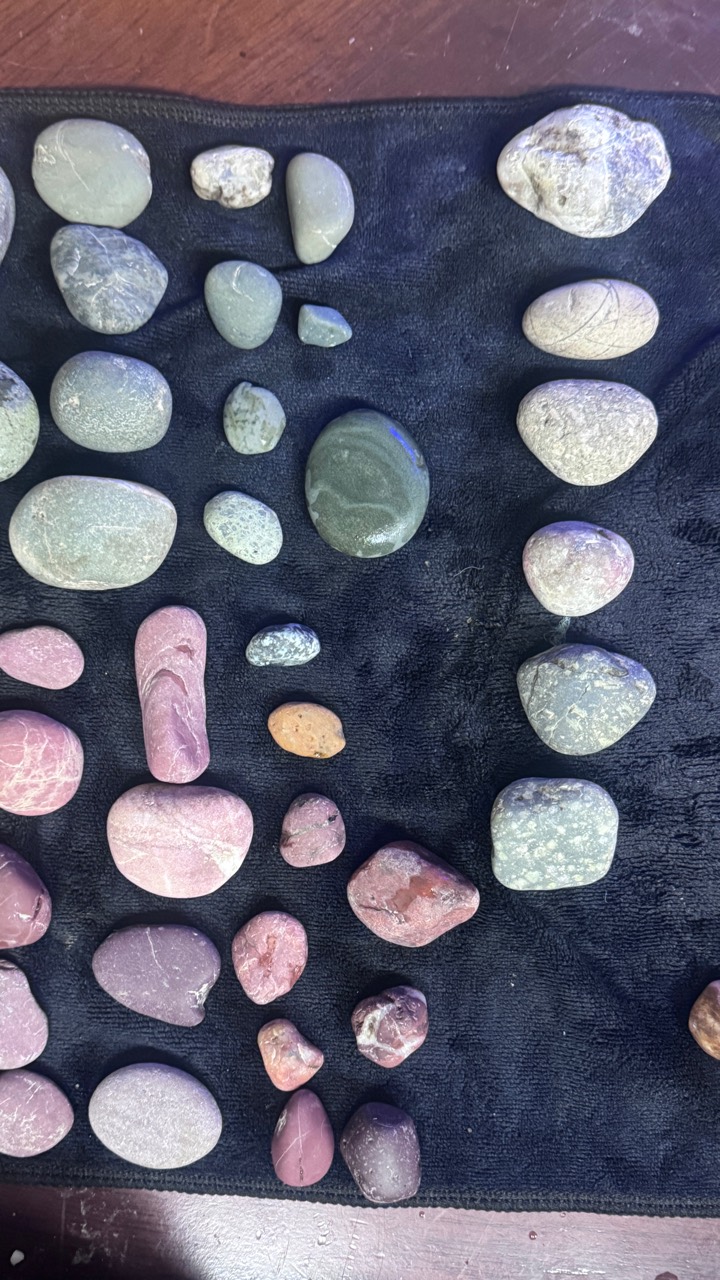
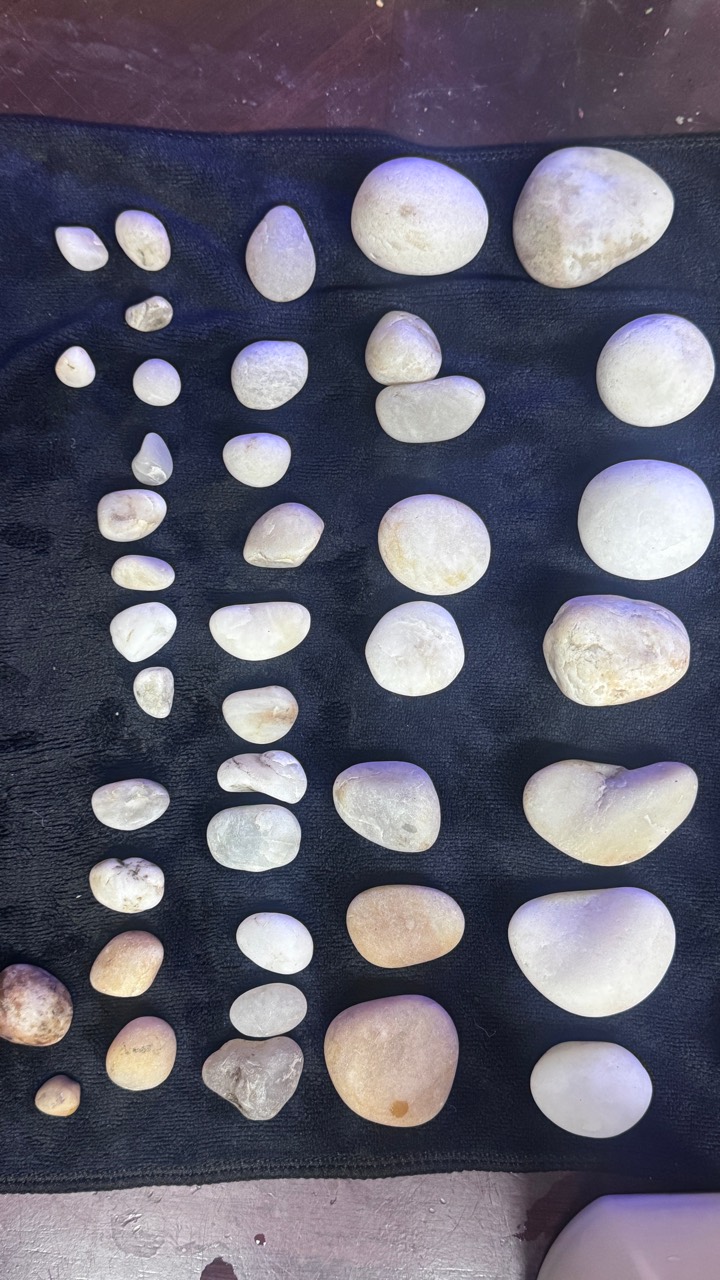
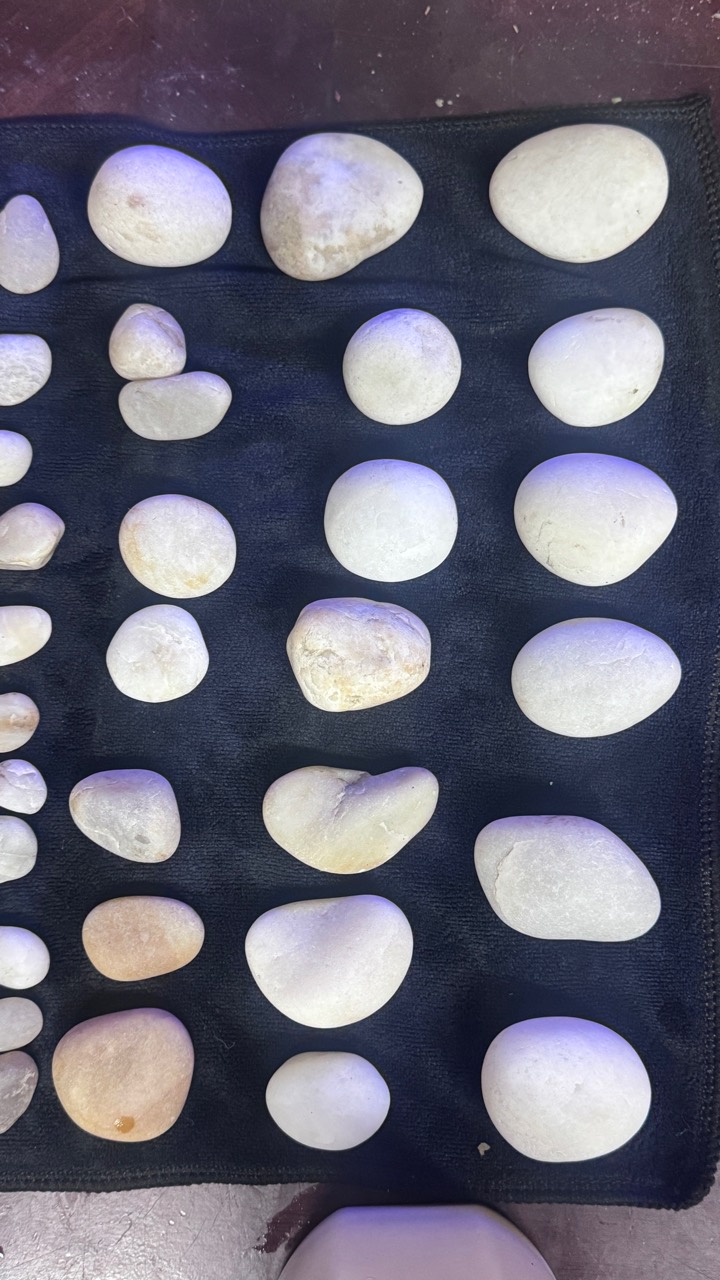
I found these stones on a gravel bar in Chilliwack on October 18. Laid out on a black towel, the collection falls into reds, greens and a whole spread of whites. Ten photographs cover the haul from different angles.
My first questions were pretty basic. Are the red ones jasper? Could any of the greens be aventurine or jade? And what have I got in that white pile: agate, quartz, something else?
The later photo review counted 100 distinct stones. There are 52 coloured or mixed pieces and 48 in the white group. Every stone now has a number, so “that little red one” can become a useful conversation.
The reds and the stripey ones
#7 is the mustard-and-red piece. The photo review puts jasper or iron-stained chert at the top of its list. Fine pale veins run through those warm colour patches. It belongs near the front of the collection.
#26 is the long red pebble with sweeping curved bands. Another jasper or chert candidate, although a banded volcanic or sedimentary rock remains possible. #18 and #42 bring the red-and-white veinwork: branching lines on one, a more broken-up pattern on the other.
Then there's #10, with those bold dark stripes. Its working identification is a banded sedimentary rock that may have been metamorphosed. The pattern alone earns it a place. #47 and #48, the spotted green-grey pieces, are possible porphyritic volcanic rocks, with pale crystal-like flecks in a darker body.
Green questions, white questions
#44 is the green one to follow up. Dark body, sweeping pale bands, smooth surface. Greenstone or green chert leads the current shortlist. Serpentinite is another possibility. Jade remains unconfirmed, and it isn't the leading guess.
Most of the white group looks like milky quartz or quartzite in the photographs. #69 stands out for its translucent appearance, with quartz ahead of possible chalcedony. #91 has honey-white colour and a working identification of iron-stained vein quartz.
The photographs haven't established aventurine or agate either. Those names stay in the question column.
Next on the bench
These identifications came from an AI-assisted review of the photographs after the outing. No physical tests are recorded. Chilliwack is the recorded locality; the exact river and gravel bar haven't been recorded.
Next move: measure #44's density with a scale reading to 0.01 g, then add the result to its numbered entry. That can help narrow the candidates. It won't settle the jade question by itself.
The collection
A number for every stone
Photo 10 is the numbering key
Select a number for the best guess, an alternative and the visible clues. Favourites mark colour, pattern or a useful follow-up, not confirmed mineral value.
Pull aside first
100 of 100 stones
Slide the photograph sideways to reach every number.
Stone 7
★ A favourite
Tentative visual shortlist
Yellow-red jasper / iron-stained chert
Also possible: Silicified fine-grained volcanic rock
Smooth mustard and red colour patches with fine pale veins; one of the strongest jasper candidates.
First pick for colour and possible jasper polishing.
Full catalog · 100 matching stones
The search and filters above also apply here. Every entry is a tentative visual shortlist.
All matching stones with provisional identifications, alternatives and visual clues
No.
Best guess
Alternative
Visible clues
Pink quartzite with a pale vein
Banded red chert
Large pale-pink pebble with a broad white band and fine granular-looking skin.
Veined red quartzite or silicified sedimentary rock
Red chert
Large flattened mauve cobble with many pale cross-cutting veinlets; grain size is unresolved.
Reddish quartzite
Fine-grained volcanic rock
Pale granular-looking rind around a red interior; the weathered surface obscures texture.
Serpentinite candidate
Altered greenstone; nephrite is a lower-ranked possibility
Large mottled green cobble with irregular pale vein networks. Colour and a smooth skin do not establish jade.
Veined green-grey metasedimentary rock
Bedded green chert
Parallel pale seams and a few cross-cutting veins; no visible agate-style cavity bands.
Laminated siltstone or argillite
Banded chert or fine volcanic rock
Close parallel light-dark laminae. Wood-like appearance alone is insufficient; no wood cells or growth rings are resolved.
Yellow-red jasper / iron-stained chert
Silicified fine-grained volcanic rock
Smooth mustard and red colour patches with fine pale veins; one of the strongest jasper candidates.
Porphyritic volcanic rock
Weathered red chert with pits
Numerous pale flecks and dark pits in a red groundmass favour a volcanic texture over uniform jasper.
Fine-speckled greenstone
Green quartzite or fine intrusive rock
Evenly scattered pale grains in a green-grey matrix. No distinctive mica-flash evidence for aventurine.
Banded metasedimentary rock
Ribbon chert
Repeated dark stripes across the whole pebble resemble bedding. A standout display stone; not enough evidence for agate.
Pink-grey quartzite
Fine sandstone or chert
Small pale rounded pebble with a uniformly granular-looking surface.
Pink quartzite
Silicified sandstone
Pale, evenly speckled oval; more granular-looking than the dense red chert candidates.
Altered volcanic rock with a red patch
Brecciated chert with pale mineral fill
Mixed grey-green and pink areas plus a rough cavity; too heterogeneous for a simple jasper call.
Red chert / jasper candidate
Very fine red metasedimentary rock
Compact, relatively uniform red body with fine pale veinlets; a promising solid-colour keeper.
Pink quartzite
Red chert
Fine pale speckling on a pink surface; actual grain texture remains unclear.
Veined red chert
Pink quartzite
Angular outline and pale crack-filling veins through a compact pink-red body.
Dark red chert / jasper
Fine-grained red volcanic rock
Dense-looking burgundy body, smooth faces and thin white veinlets; good small keeper.
Veined red chert / jasper
Veined red quartzite
Attractive branching pale vein network across a rounded red pebble; fractures may matter if later polished.
Fine pink quartzite
Red chert
Small pale-pink oval with fine speckling; not enough detail to distinguish grains from weathering.
Fine greenstone
Green chert
Small blue-green oval with dispersed pale dots and a light rind.
Altered greenstone, possibly epidote-rich
Serpentinite; nephrite is not established
Pistachio-green granular-looking body, dark patch and a prominent vein or crack.
Green altered volcanic rock
Chlorite-rich quartzite or schist
Elongate pale-green speckled pebble; visible heterogeneity is more suggestive of a mixed rock than uniform jade.
Pale pink-grey quartzite
Fine sandstone
Evenly granular-looking pale oval.
Purple-red chert
Argillite
Smooth dark body, thin white vein and a small chipped edge; a stronger fine-silica candidate.
Banded pink quartzite
Banded red chert
Pale pink pebble with several near-parallel light bands; no clear cavity-filling structure.
Banded red chert / jasper candidate
Flow-banded volcanic rock or laminated siltstone
Long red pebble with sweeping curved bands. Excellent pattern; curvature alone does not prove agate.
Veined greenstone
Green quartzite
Pale granular speckling and a white cross-cutting vein in a green-grey body.
Fine-speckled greenstone
Green quartzite
Rounded grey-green pebble with abundant fine pale grains.
Veined serpentinite or greenstone
Green chert
Dark green-grey mottling cut by pale veins; the surface does not resolve a diagnostic mineral texture.
Pale green chert
Fine greenstone; compact serpentine is possible
Relatively uniform body with thin white veins, but no fresh fracture is shown.
Red chert / jasper
Fine red argillite
Small smooth red pebble crossed by thin pale lines; an attractive compact silica candidate.
Yellow-red jasper / chert
Iron-stained quartz-rich volcanic rock
Small angular pebble with contrasting warm colour patches and a pale seam.
Brecciated red chert / jasper
Reddish volcanic breccia
Irregular red patches and pale healed fractures; a good small patterned candidate.
Veined red chert
Fine volcanic rock
Small pink-red pebble with a dark oblique seam and limited visible texture.
Ochre jasper / iron-stained chert
Iron-stained fine sandstone
Mustard-yellow body with a few pits; texture is too small to resolve conclusively.
Porphyritic greenstone
Fine diorite
Distinct white spots or crystals in a dark green matrix.
Spotted altered volcanic rock
Epidote-bearing fine intrusive rock
Mottled pale green pebble with darker small spots; resembles a mixed crystalline rock.
Green-inclusion-bearing quartz-rich pebble
Mottled altered volcanic rock
Pale body with irregular green internal-looking patches. Moss-like appearance alone does not establish moss agate.
Green chert candidate
Fine greenstone
Small smooth green pebble with pale fine veins and no obvious large crystals.
Quartz-rich rock with dark inclusions
Pale altered volcanic rock
Small rough white-and-grey mottled piece; appears heterogeneous rather than uniform jade.
Fine porphyritic volcanic rock
Dark weathered chert
Dark rounded pebble with small pale dots and a lighter weathered border.
Brecciated red chert / jasper with pale veins
Veined volcanic rock
Strong red-white contrast and irregular pale mineral fill make this an appealing small keeper.
Red chert / jasper with weathered rind
Silicified volcanic rock
Angular red interior-looking patch surrounded by a paler skin; one of the better jasper follow-ups.
Fine greenstone or green chert
Serpentinite; nephrite is worth testing but not the leading call
Dark green pebble with sweeping pale bands and a smooth wet-looking surface. Best green follow-up specimen, not confirmed jade.
Green chert candidate
Fine greenstone
Tiny compact angular green piece; too little surface detail for a firm call.
Pale green chert candidate
Fine greenstone or compact serpentine
Elongate smooth pale-green pebble; uniform appearance but no diagnostic fracture or mineral habit.
Porphyritic volcanic rock
Amygdaloidal volcanic rock
Many large pale spots in a dark green matrix. Some look like crystals; others could be mineral-filled vesicles.
Porphyritic volcanic rock
Volcanic breccia
Angular pale crystal-like flecks in a green-grey fine matrix; an excellent texture specimen.
Altered porphyritic volcanic rock
Mottled quartz-rich metamorphic rock
Mixed pale-green and pink areas with a speckled texture; exact minerals are unresolved.
Pale porphyritic volcanic rock
Fine granitoid
Abundant pale crystalline-looking flecks in a grey matrix; not a uniform quartz pebble.
Fine sedimentary or metamorphic pebble with dark seams
Fine quartzite
Cream-grey oval with curved hairline dark markings. No diagnostic fossil or agate structure is visible.
Vein quartz with host-rock inclusions
Quartz-rich granitoid or metamorphic rock
Rough white-grey mass with coarse-looking quartz patches and darker host material.
Iron-stained quartz pebble
Pale quartzite
Tiny cream-tan pebble; too small in these views for a diagnostic texture.
Iron-stained vein quartz
Quartz-rich mixed rock
White and honey-brown mottling suggests a quartz-rich pebble with surface staining.
Milky quartz
White quartzite
Small white triangular pebble with a faint internal-looking streak; no visible bands.
Milky quartz
Pale chalcedony
Small smooth whitish pebble with a slightly translucent-looking edge.
Iron-stained quartzite
Stained vein quartz
Rounded yellow-cream pebble with a fairly uniform dull surface.
Tan quartzite
Iron-stained vein quartz
Warm tan, rounded pebble with a fine sugary-looking surface in the closer view.
Quartz with dark inclusions
Quartz-rich mixed rock
White pebble contains visible dark flecks and rusty patches.
Milky quartz
Quartz-rich mixed pebble
Small grey-white pebble has cloudy patches and a few darker inclusions.
Quartz-rich pebble
Fine-grained pale rock with a quartz vein
Small angular grey-white piece appears mottled rather than uniformly glassy.
Milky vein quartz
White quartzite
White triangular pebble shows a conspicuous pale fracture or vein-like line.
Cream quartzite
Iron-stained quartz
Small elongated cream pebble has a uniformly fine, dull surface.
Milky quartz with inclusions
Quartz-rich mixed rock
Whitish rounded pebble has a pale brown central patch and irregular cloudy texture.
Translucent quartz fragment
Pale chalcedony
Small grey-clear piece shows a comparatively glassy, chipped-looking face.
Milky quartz
White quartzite
Small rounded white pebble with even colour and no obvious banding.
Quartz-rich mixed pebble
Stained vein quartz
Tiny pale mottled pebble contains darker grey-brown material.
Milky quartz with inclusions
Pale quartzite
Small cream-white oval carries faint darker streaks or inclusions.
Translucent vein quartz
Grey chalcedony
Angular grey-clear pebble has more visible fracture surfaces than the rounded whites; no diagnostic agate bands.
Cloudy quartz
Pale quartzite
Small oval grey-white pebble appears cloudy and slightly translucent in the close view.
Milky quartz
White quartzite
Small white rounded pebble has a fairly uniform cloudy appearance.
Vein quartz
Pale quartzite
Squarish grey-white pebble shows cloudy zones and intersecting pale internal-looking lines.
Milky quartz fragment
Quartz-veined pale rock
Elongated double-lobed piece has a conspicuous fracture and contrasting white zones.
Iron-stained quartz
Pale quartzite
Cream pebble contains a localized honey-brown patch rather than continuous agate banding.
Milky vein quartz
White quartzite
Elongated white pebble has cloudy translucent-looking areas and pale fracture lines.
Cloudy vein quartz
Grey quartzite
Irregular pale grey pebble shows a brighter white edge and cloudy interior.
Milky quartz
White quartzite
Small rounded triangular white pebble has a uniformly cloudy face.
White quartzite
Milky vein quartz
Rounded squarish pebble has a pale granular-looking surface in the closer view.
Pale quartzite
Cloudy vein quartz
Flat teardrop-shaped grey-white pebble has an even fine-grained-looking surface.
Iron-stained quartzite
Iron-stained vein quartz
Large cream-tan pebble has a sugary-looking surface and one darker orange spot.
Tan quartzite
Iron-stained vein quartz
Uniform tan oval shows fine pale speckling; no visible agate banding.
Cloudy quartz with inclusions
Pale quartzite
Triangular grey-white piece has uneven cloudy patches and a small darker inclusion.
Milky vein quartz
White quartzite
Rounded white piece has irregular pale internal-looking fractures in the close view.
Iron-stained milky quartz
White quartzite with staining
White rounded pebble has localized yellow staining around part of its edge.
Cloudy vein quartz
Pale quartzite
Elongated grey-white pebble shows translucent-looking cloudy zones without distinct bands.
Milky quartz
White quartzite
Rounded triangular cream-white pebble shows an irregular cloudy surface.
White quartzite
Milky vein quartz
Very rounded white pebble has a fine sugary-looking texture and slight beige staining.
Milky quartz
White quartzite
Small smooth oval is uniformly milky white; the purple highlight follows the lighting.
Milky quartz
White quartzite
Large kidney-shaped white pebble appears cloudy and massive with no visible bands.
Cream quartzite
Iron-stained vein quartz
Curved cream pebble has a fine granular-looking surface and a dark line across its notch.
Iron-stained vein quartz
Quartz-rich breccia
Chunky white-and-honey pebble has conspicuous irregular veining or fractured-looking internal texture.
Milky quartz
White quartzite
Rounded white pebble shows a cloudy, fairly uniform face without clear agate banding.
White quartzite
Milky vein quartz
Rounded white pebble has a finely speckled sugary-looking surface.
Iron-stained milky quartz
Stained white quartzite
Large triangular white pebble has cloudy grey and beige patches rather than regular bands.
Milky quartz
White quartzite
Large rounded white pebble has a cloudy massive face and minor surface pits.
White quartzite
Milky vein quartz
Elongated white pebble has a fine sugary-looking surface with one pale edge seam.
White quartzite
Milky vein quartz
Large white oval has a fairly uniform fine granular-looking surface.
Milky quartz
White quartzite
White oval shows a few faint fractures and inclusions but no visible agate banding.
Milky quartz
White quartzite
White oval pebble has cloudy zones and a few darker flecks near one edge.
White quartzite
Milky vein quartz
Large white oval has an even fine sugary-looking surface in the close photograph.
Use a scale that reads to 0.01 g. This cup-on-scale method estimates specific gravity (SG); it can narrow the shortlist but cannot identify jade by itself.
Weigh the clean, dry stone. Record its mass as A.
Put a cup of water on the scale and tare it to zero.
Suspend the stone fully underwater from a support independent of the scale. Keep it off the cup's sides and bottom, and remove trapped bubbles.
Record the increase on the scale as B. Estimate SG = A ÷ B. Repeat to check the reading.
Around 2.5–2.7 can fit lighter serpentine-rich material, quartz or chert. Around 2.9–3.1 can fit nephrite, but greenstone, epidote-bearing rocks, rodingite and prehnite-bearing material overlap parts of that range. A number in the jade range is a reason to investigate, not a jade identification.
Do not dry-grind or cut possible serpentinite before it is identified; some varieties contain hazardous fibres. Start with this non-destructive test.
These show the same collection from different angles. Numbers refer only to the overhead key in Photo 10.
Photo 1 · Open originalPhoto 2 · Open originalPhoto 3 · Open originalPhoto 4 · Open originalPhoto 5 · Open originalPhoto 6 · Open originalPhoto 7 · Open originalPhoto 8 · Open originalPhoto 9 · Open originalPhoto 10 · Numbering key · Open original